On this page
- What is the WEF Future of Jobs Report?
- Which skills are on the rise to 2030?
- Which core skills do employers want today?
- How much of a worker’s skill set will change?
- Which jobs will grow and decline?
- What is driving the change?
- How are employers responding: reskilling and upskilling
- What do employers want from governments?
- How to read the Future of Jobs numbers
Search for the Forum’s jobs report and you find many summaries that each quote a different list: top skills, top jobs, a headline job count. The lists come from different chapters, and some belong to different editions. This page lays out the three most recent editions side by side, starts with the skills that readers ask about most, and shows how each figure is defined so that an older number is never read as a current one. For the wider policy picture, see the policy section.
What is the WEF Future of Jobs Report?
The Future of Jobs Report is an employer survey on how jobs and skills will change over roughly the next five years. The Forum calls it a bi-annual report, and the 2025 edition is the fifth1. The 2025 report draws on over 1,000 employers, representing more than 14 million workers across 22 industry clusters and 55 economies1. It sorts skills with the Forum’s own Global Skills Taxonomy1.
Because respondents are employers, every figure is a stated expectation, not a measured outcome. That makes the survey a good guide to what companies plan and a poor one to what will happen, which is why the numbers move from one edition to the next.
| 2020 edition | 2023 edition | 2025 edition | |
|---|---|---|---|
| Survey base | 15 industry clusters, 26 countries, 80% of world GDP3 | 803 companies, more than 11.3 million workers, 27 industry clusters, 45 economies2 | Over 1,000 employers, more than 14 million workers, 22 industry clusters, 55 economies1 |
| Jobs displaced and created | 85 million displaced, 97 million new roles by 20253 | 83 million lost, 69 million created, a net loss of 14 million or 2%2 | 92 million displaced, 170 million created, a net gain of 78 million1 |
| Share of skills expected to change | 57%1 | 44%2 | 39%1 |
| Most-cited core skill | Analytical thinking and innovation ranks first of the top 15 for 20253 | Analytical thinking, with creative thinking second2 | Analytical thinking, 69% of employers1 |
The horizons differ, the samples differ, and the clusters differ, so read the columns as three snapshots and not as one trend line. The 2025 report does that comparison itself for skill change, restating the 2020 and 2023 values on one scale1. The jobs row is the one most often misquoted. Ranges of 85 million, 83 million and 170 million are not a trend in anything: they come from different samples, scaled up in different ways3,2,1. The automation and jobs page puts these three surveys next to the academic estimates.
Which skills are on the rise to 2030?
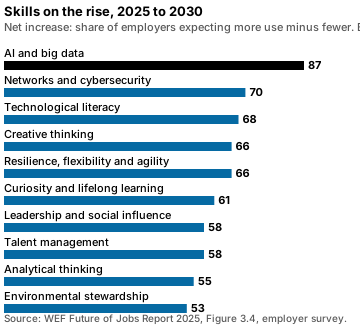
AI and big data top the list of fastest-growing skills, followed closely by networks and cybersecurity and by technology literacy1. The chart ranks the ten skills with the biggest net increase, which is the share of employers expecting a skill to be used more minus the share expecting it to be used less.
| Rank | Skill on the rise, 2025 to 2030 | Net increase |
|---|---|---|
| 1 | AI and big data | 871 |
| 2 | Networks and cybersecurity | 701 |
| 3 | Technological literacy | 681 |
| 4 | Creative thinking | 661 |
| 5 | Resilience, flexibility and agility | 661 |
| 6 | Curiosity and lifelong learning | 611 |
| 7 | Leadership and social influence | 581 |
| 8 | Talent management | 581 |
| 9 | Analytical thinking | 551 |
| 10 | Environmental stewardship | 531 |
The list has a clear shape: three technical skills at the top, then a block of human skills. Creative thinking, resilience and curiosity sit between the technical skills and the leadership skills, so the employers surveyed do not see the future as technical skills replacing human ones1. Environmental stewardship is new to the top ten: climate trends are expected to drive more focus on it, and it appears there for the first time in this series1.
Skills in decline
Few skills are expected to lose ground outright. Manual dexterity, endurance and precision show the clearest net decline, with 24% of respondents expecting them to matter less1. The 2023 edition found something similar: it judged no skill to be in net decline, while sizable minorities of employers expected manual dexterity, endurance and precision to matter less2. In the core-skill ranking, the 2025 edition found that dependability, attention to detail and quality control lost importance compared with the 2023 data1.
One more distinction matters for readers who care about careers or training budgets. The skills that most separate growing jobs from declining ones are resilience, flexibility and agility, resource management and operations, quality control, programming and technological literacy1. These are the gaps a worker would cross by moving from a declining role to a growing one, which is a different question from which skills are rising overall.
Which core skills do employers want today?
Analytical thinking remains the top core skill for employers, named by seven out of ten companies, as in the two previous editions1. Resilience, flexibility and agility come second and leadership and social influence third, with creative thinking fourth and motivation and self-awareness fifth1. Core skills are the ones employers consider essential for their workforce today, so this ranking reflects the present, not the 2030 outlook above.
| Rank | Core skill, 2025 | Share of employers |
|---|---|---|
| 1 | Analytical thinking | 69%1 |
| 2 | Resilience, flexibility and agility | 67%1 |
| 3 | Leadership and social influence | 61%1 |
| 4 | Creative thinking | 57%1 |
| 5 | Motivation and self-awareness | 52%1 |
| 6 | Technological literacy | 51%1 |
| 7 | Empathy and active listening | 50%1 |
| 8 | Curiosity and lifelong learning | 50%1 |
| 9 | Talent management | 47%1 |
| 10 | Service orientation and customer service | 47%1 |
The ranking mixes cognitive skills, self-management and working with others, and the top five contain all three kinds1. Against the 2023 edition, leadership and social influence, resilience, flexibility and agility, and AI and big data gained the most importance, by 22, 17 and 17 percentage points in the share of employers calling them core1. The same comparison finds dependability, attention to detail and quality control down1.
Averages hide sector differences. In insurance and pensions management, 83% of respondents call curiosity and lifelong learning a core skill, against 50% across all sectors worldwide1. Skill priorities follow the work: a broad ranking like this one is a starting point, and a sector’s own list can differ a lot from it.
How the ranking changed since 2020
The 2020 edition’s top 15 skills for 2025 began with analytical thinking and innovation, active learning and learning strategies, complex problem-solving, critical thinking and analysis, and creativity, originality and initiative3. Places six to eight went to leadership and social influence, technology use, monitoring and control, and technology design and programming3. The 2023 edition kept analytical thinking and creative thinking on top, with technology literacy the third-fastest growing core skill2. Analytical thinking has been first in all three editions. What changed is the supporting cast: learning strategies and problem-solving in 2020, creative thinking in 2023, and technological and AI skills rising fastest in 20253,2,1.
How much of a worker’s skill set will change?
On average, workers can expect that two-fifths (39%) of their existing skill sets will be transformed or become outdated over the 2025 to 2030 period1. The Forum calls this measure skill instability, and it has slowed from 44% in 2023 and a high point of 57% in 2020, in the wake of the pandemic1. The first edition in 2016 had surveyed companies predicting that 35% of workers’ skills would be disrupted over the following five years2.
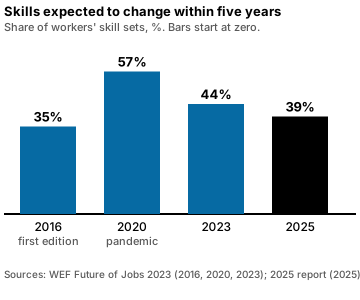
The decline may reflect training that has already happened. The share of workers who completed training, reskilling or upskilling measures rose to 50%, from 41% in the 2023 edition1. If more workers have already moved, fewer skills look at risk in the next five years. The 2020 survey is an outlier for another reason: the 2023 report ties its 57% to the pandemic disruption in working life of that year2.
Worked example (our arithmetic). The three surveys give one series, and the gaps between points show the slope.
| Step | Calculation | Result |
|---|---|---|
| Fall from the 2020 peak to 2025 | 57 − 39 | 18 points1 |
| Fall from 2023 to 2025 | 44 − 39 | 5 points1 |
| Fall from 2020 to 2023 | 57 − 44 | 13 points2 |
| Rise from 2016 to 2020 | 57 − 35 | 22 points2 |
The sharpest movement was the pandemic jump of 22 points and the 13-point fall that followed1,2. Since then, the change has been small. Skill instability is still high at 39%, but it is no longer rising.
Which jobs will grow and decline?
Employers expect the fastest percentage growth in technology roles: big data specialists, fintech engineers, AI and machine learning specialists and software and applications developers1. The table gives the ten fastest-growing and ten fastest-declining roles in the order employers ranked them1.
| Fastest-growing jobs, 2025 to 2030 | Fastest-declining jobs, 2025 to 2030 |
|---|---|
| Big data specialists | Postal service clerks |
| Fintech engineers | Bank tellers and related clerks |
| AI and machine learning specialists | Data entry clerks |
| Software and applications developers | Cashiers and ticket clerks |
| Security management specialists | Administrative assistants and executive secretaries |
| Data warehousing specialists | Printing and related trades workers |
| Autonomous and electric vehicle specialists | Accounting, bookkeeping and payroll clerks |
| UI and UX designers | Material-recording and stock-keeping clerks |
| Light truck or delivery services drivers | Transportation attendants and conductors |
| Internet of Things specialists | Door-to-door sales workers, news and street vendors |
The table ranks by percentage change, which favors small, fast-growing occupations. Ranked by absolute numbers, the picture reverses: frontline roles see the largest growth, including farmworkers, delivery drivers, construction workers, salespersons and food processing workers1. Clerical and secretarial workers are expected to see the largest decline in absolute numbers1. A reader who wants to know where most new jobs will be should look at the absolute list, and one who wants the trend in skills should look at the percentage list.
Earlier editions pointed the same way. In 2023, AI and machine learning specialists topped the fast-growing jobs, followed by sustainability specialists, business intelligence analysts and information security analysts, and the fastest-growing roles were driven by technology, digitalization and sustainability2. Overall, employers in 2025 expect creation and destruction of jobs to amount to 22% of today’s total jobs1. That breaks into new jobs equivalent to 14% of total employment, or 170 million, offset by displacement of 8%, or 92 million, for net growth of 7%, or 78 million jobs1.
What is driving the change?
Employers name a mix of technology, economic and demographic forces. Broadening digital access is the most transformative trend, with 60% of employers expecting it to transform their business by 20301. Advances in AI and information processing (86%), robotics and automation (58%), and energy generation, storage and distribution (41%) are also expected to be transformative1.
| Trend | Share of employers expecting transformation by 2030 |
|---|---|
| Broadening digital access | 60%1 |
| AI and information processing | 86%1 |
| Robotics and automation | 58%1 |
| Energy generation, storage and distribution | 41%1 |
| Increasing cost of living | Half of employers1 |
| General economic slowdown | 42%1 |
| Climate-change mitigation and adaptation | 47% and 41%1 |
| Geoeconomic fragmentation | 34%1 |
Read it as a list of concerns, not a ranked score. Demography adds a second pull. Aging populations drive growth in healthcare jobs such as nursing professionals, while growing working-age populations fuel growth in education-related professions such as higher education teachers1.
The 2023 edition framed technology adoption in similar terms. Digital platforms and apps were the technologies most likely to be adopted, with 86% of companies expecting to incorporate them, and AI was expected to be adopted by nearly 75% of surveyed companies2. Employers also estimated that machines then performed 34% of business-related tasks and humans 66%2.
The labour-market backdrop
Two labour-market figures frame the survey. The jobs gap, a measure that counts both unemployment and underemployment, stood at a need for 402 million additional jobs in 20241. Global youth unemployment remains elevated at 13%1.
How are employers responding: reskilling and upskilling
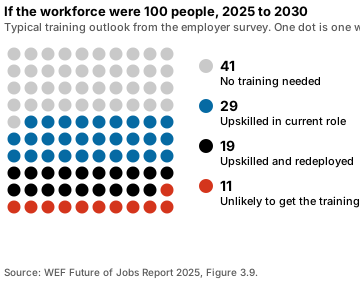
The Forum’s most quoted training figure comes from a thought experiment. If the world’s workforce were made up of 100 people, 59 would need training by 20301. Of these, employers foresee that 29 could be upskilled in their current roles and 19 could be upskilled and redeployed elsewhere within their organization, while 11 would be unlikely to receive the reskilling or upskilling needed1.
Worked example (our arithmetic). Rebuilding the 100-worker split from the survey’s own pieces shows what it implies1.
| Step | Calculation | Result |
|---|---|---|
| Workers needing training | 29 + 19 + 11 | 59 of 1001 |
| Workers not needing training | 100 − 59 | 41 of 1001 |
| Share of those needing training who are unlikely to get it | 11 ÷ 59 | about 19%1 |
| Share of those needing training who stay in their current role | 29 ÷ 59 | about 49%1 |
Roughly one in five workers who need training would not receive it in this typical group, so the shortfall employers foresee is in who gets training. The share of employees unlikely to receive upskilling is somewhat uniform across industries and geographies, which suggests that access to training is similarly constrained everywhere1. Need varies more: companies headquartered in North America estimate that 67% of their workforce will require training by 20301, and telecommunications and information technology services expect 63% and 62% of their workforce, respectively, to need further training1.
Skill gaps are the barrier that employers cite most, with 63% identifying them as a major barrier to business transformation1. Their plans follow.
| Workforce strategy, 2025 to 2030 | Share of employers |
|---|---|
| Prioritize upskilling the workforce | 85%1 |
| Accelerate process and task automation | 73%, down from 80% in 20231 |
| Hire staff with new skills | 70%1 |
| Transition staff from declining to growing roles | 50%1 |
| Reduce staff whose skills are becoming less relevant | 40%1 |
Half of employers plan to reorient their business in response to AI, two-thirds plan to hire talent with specific AI skills, and 40% anticipate reducing their workforce where AI can automate tasks1. The 2020 edition gives context for how little time employers think training takes. On average, companies estimated that around 40% of workers would require reskilling of six months or less, and 94% of business leaders expected employees to pick up new skills on the job, up from 65% in 20183. That edition also found only 42% of employees taking up employer-supported reskilling and upskilling opportunities3, and 66% of employers expected a return on that investment within one year3.
What do employers want from governments?
When asked which public policies would most increase access to talent, employers named funding for reskilling and upskilling (55%) and provision of reskilling and upskilling (52%) as the two most crucial measures1. Improving public education systems ranks third, with 47% of respondents, up from fourth place in the 2023 edition1. On the business side, supporting employee health and well-being rose from ninth place in 2023 to first, with 64% of employers seeing promise in it1. Wages are part of the same picture: 52% of employers expect to put a greater share of revenue into wages by 2030, and only 8% expect a smaller one1.
These are employer preferences, not evidence that each measure works. For what governments can do to attract and keep skilled people, see international talent mobility; for what mismatches look like in the data, see skills mismatch.
How to read the Future of Jobs numbers
Three cautions cover most misreadings.
- Expectations, not measurements. Every number comes from an employer survey, with a sample that changes by edition3,2,1.
- Exposure is not loss. In the ILO’s index, one in four jobs globally (24%) has some degree of exposure to generative AI, but exposure does not imply the immediate automation of an entire occupation, only the potential for a large share of its tasks to be done with the technology5. Transformation of jobs is the most likely impact5.
- Early evidence is milder than forecasts. The OECD found that the impact of AI on job levels has been limited so far, and that more than replacing jobs, AI is changing them and the skills they require4. Employers in its survey said AI raised the importance of specialized AI skills and raised the importance of human skills even more4.
The same theme runs through the Global Talent Competitiveness Index. Its 2017 edition added an Employability sub-pillar, measuring the extent of skill gaps and labor market mismatches in each country, and its first message was “Think beyond automation”6. Its 2020 edition, on artificial intelligence, concluded that the emergence of AI in the workplace requires a massive re-skilling of the workforce and that human-AI teams could be more productive than either AI or workers alone7. The talent and technology page follows how the 2017 theme compares with the Forum’s findings, and the GTCI methodology explains how the index turns such indicators into scores.
An editor’s rule for any figure from this series: give the edition year, the horizon and the sample before the number. A “top skill” without those is a headline, not a finding.
RelatedTalent and technology shaping the future of workHow many jobs will automation replace? Studies comparedSkills mismatch: OECD definitions, data and costs
Sources
- Future of Jobs Report 2025 · World Economic Forum, January 2025 · www3.weforum.org · checked October 21, 2026
- Future of Jobs Report 2023 · World Economic Forum, 2023 · www3.weforum.org · checked October 21, 2026
- The Future of Jobs Report 2020 · World Economic Forum, October 2020 · www3.weforum.org · checked October 21, 2026
- OECD Employment Outlook 2023: Artificial Intelligence and the Labour Market · OECD, 2023 · oecd.org · checked October 21, 2026
- Generative AI and Jobs: A Refined Global Index of Occupational Exposure (ILO Working Paper 140) · International Labour Organization, May 2025 · ilo.org · checked October 21, 2026
- The Global Talent Competitiveness Index 2017: Talent and technology · INSEAD, Adecco Group and HCLI, GTCI 2017 · globaltalentcompetitivenessindex.org · checked October 21, 2026
- The Global Talent Competitiveness Index 2020: Global talent in the age of artificial intelligence · INSEAD, the Adecco Group and Google, GTCI 2020 · globaltalentcompetitivenessindex.org · checked October 21, 2026
Image credits (3)
Published . Rankings change with every edition: each figure names its edition year and each source shows the day it was checked. How we check facts · Report an error.