A talent index is an odd place to look for the future of work. It ranks countries, not tasks. Yet the 2017 edition of the GTCI chose technology as its theme, and came back with seven messages that read, with hindsight, like a checklist for the next decade1. That makes them testable. Some of the evidence has since moved to numbers: employer surveys from the World Economic Forum, a task-level exposure index from the ILO, and an AI chapter from the OECD. This page sets the messages against that evidence and rates each one.
Why technology was the theme
The theme was a bet on a side of a long argument. Detractors say technology impoverishes workers, supporters say it relieves toil and creates new posts, and the 2017 Adecco foreword leaned to the second view, saying the edition analyses how technology can indeed augment human efficiency1. The Human Capital Leadership Institute’s foreword was darker. Jobs, it said, were being created and destroyed at an unprecedented rate, and the old reassurance that technology merely moves jobs around was “perhaps less of a fallacy” than it used to be1.
Two ideas held the edition together. Technology boosts growth by raising productivity and lowering costs, but also brings, temporarily at least, potential skills shortages as new types of human expertise become necessary1. And the new expertise is not only technical: the edition highlights “softer” talents such as creativity, adaptability and the ability to work in teams1.
The index tied the theme to its model. The 2017 model added an Employability sub-pillar under Vocational and Technical Skills, measuring skill gaps and labour market mismatches in each country1. The full table of that edition’s results is on the 2017 results page. This page follows the argument instead.
Seven messages, nine years later
Technical skills PLUS social/project competence is the new talent profile.1
The 2017 report listed seven key messages1. The table gives each one in short form, the later evidence, and the editor’s reading of how it has aged. The verdicts are judgements, grounded in the cited lines and no more certain than the evidence.
| 2017 message | Later evidence | Editor’s reading |
|---|---|---|
| 1. Think beyond automation1 | For the time being AI is changing jobs and the skills they need more than it is replacing them6. Transformation of jobs is the most likely impact of generative AI5. | Held |
| 2. Technology is changing the nature of work1 | The report put free agents at nearly 30% of the population in Europe and the United States1. The later sources here do not measure free agents. | Direction plausible, figure untested here |
| 3. Technical plus social skills are the new profile1 | After analytical thinking, employers rank resilience, flexibility and agility, then leadership and social influence3. AI has raised the importance of human skills even more than specialised AI skills6. | Held strongly |
| 4. Education and employment policy must adapt1 | Skill gaps are the biggest barrier to business transformation, cited by 63% of employers3. | Held, and now measured |
| 5. Change succeeds where ecosystems are strong1 | Not tested by the sources here. | Open |
| 6. National strategies move too slowly1 | The 2020 edition found the gap between talent champions and the rest widening, with over half the developing world’s population lacking basic digital skills2. | Held for lower-income countries |
| 7. Cities and regions are showing the way1 | The 2020 edition found cities striving to become AI hubs and attract talent2. | Held |
The first message has aged best. “Think beyond automation” asked decision-makers to see the whole system moving, not only robots replacing humans: organisations, careers, and education and employment systems still founded on what the report called a fast-fading twentieth-century factory model1. The later numbers do show jobs being reshaped faster than they are removed. The report did also expect many unskilled jobs to be automated, through robots and algorithms empowered by big data1. That half of the forecast is still open: the OECD sees low- and middle-skilled jobs, among them construction, farming and production, as the most at risk6.
The third message is the most useful for readers deciding what to learn. It has been confirmed from three sides. Employers rank analytical thinking first3. The OECD finds human skills gaining more than specialised AI skills6. And the GTCI itself, in 2025, relabelled its high-level skills pillar Generalist Adaptive Skills to reflect soft cooperative skills, adaptability and interdisciplinary problem-solving7.
Jobs: created, displaced, churned
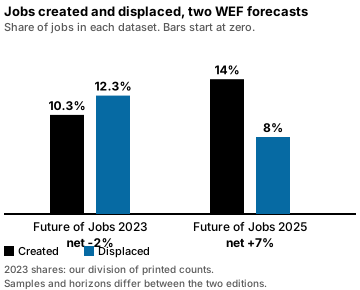
The World Economic Forum’s Future of Jobs survey is the most cited forecast of the question. The 2025 edition draws on over 1,000 employers representing more than 14 million workers in 22 industry clusters and 55 economies, and looks across 2025 to 20303. Its central estimate is 170 million jobs created and 92 million displaced, a churn of 22% of the 1.2 billion formal jobs in its dataset and a net increase of 7%, or 78 million jobs3.
The 2023 edition looked five years ahead and saw the opposite sign: 83 million jobs lost and 69 million created, a churn of 23% of the 673 million employees in its dataset, a net reduction of 14 million jobs, or 2%4.
Worked example (our arithmetic). The two editions use different samples and horizons, so the counts cannot be set against each other. Dividing each edition’s counts by its own dataset puts them on the same footing3,4.
| Edition | Created | Displaced | Net |
|---|---|---|---|
| Future of Jobs 2023 | 69 million of 673 million, 10.3% | 83 million of 673 million, 12.3% | minus 14 million, minus 2%4 |
| Future of Jobs 2025 | 170 million, 14% of the jobs in the dataset | 92 million, 8% | plus 78 million, plus 7%3 |
Two things follow. Churn, the share of jobs that change hands, is almost the same in both, 23% and 22%3,4. The balance between creation and destruction flipped within two years. A fair reading is that employers agree on how much turbulence is coming and disagree about its net direction, which is exactly where a survey of employers is weakest. Treat the sign as a mood, not a measurement.
Which jobs? The 2025 survey expects frontline roles to see the largest growth in absolute numbers, among them farmworkers, delivery drivers and construction workers, with care and education jobs also growing3. Technology roles grow fastest in percentage terms: big data specialists, fintech engineers, AI and machine learning specialists and software developers3. Clerical and secretarial workers see the largest decline in absolute numbers, and postal clerks, bank tellers and data entry clerks the fastest percentage declines3. Ageing populations push up healthcare jobs, while growing working-age populations push up education jobs3.
Skills: the 2017 profile, priced
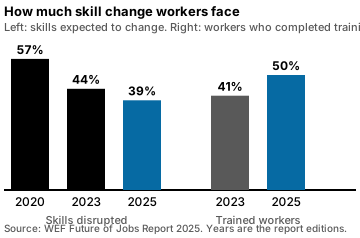
The 2017 report warned of temporary skills shortages1. Eight years later the World Economic Forum puts a number on them. Workers can expect 39% of their existing skills to be transformed or outdated over 2025 to 2030, down from 44% in the 2023 edition and a high of 57% in 20203. One possible reason: half of workers (50%) had completed training, reskilling or upskilling, against 41% in the 2023 edition3.
Worked example (our arithmetic). Employers’ 2025 picture of a workforce of 100 people: 59 need training by 2030. Of these, 29 can be upskilled in their current roles, 19 upskilled and redeployed within their organisation, and 11 are unlikely to receive the training they need3. The three groups add up to the 59: 29 + 19 + 11 = 59.
Skill gaps are the biggest barrier to business transformation, cited by 63% of employers, and 85% plan to prioritise upskilling3. In the same survey 70% expect to hire staff with new skills, 50% plan to move staff from declining to growing roles and 40% plan to reduce staff whose skills become less relevant3. The last number is the uncomfortable one: for roughly four in ten employers, the answer to a skills gap includes letting people go3.
On the skills themselves, AI and big data top the list of fastest-growing skills, followed by networks and cybersecurity and technology literacy3. Creative thinking, resilience, flexibility and agility, and curiosity and lifelong learning rise alongside3. That is the 2017 message about technical plus social skills, rendered as an employer shopping list. The 2020 edition of the GTCI added a note on how the pairing works in practice: re-skilling should develop fusion skills so that humans and machines interact in hybrid activities, and human-AI teams could be more productive than either alone2.
Who is exposed
More than replacing jobs, AI is changing them.6
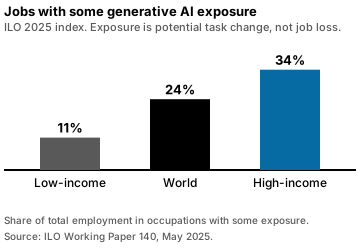
Exposure is not loss, and the sources are careful about it. The ILO’s 2025 index puts one in four workers in an occupation with some generative AI exposure, with 3.3% of employment in the highest category5. The authors stress that exposure does not imply the immediate automation of an entire occupation, only the potential for a large share of its tasks to be performed with the technology5.
The shape of exposure is lopsided. Overall exposure is 11% of employment in the low-income group, and 34% in the high-income group5. Clerical occupations have the highest exposure, and exposed roles such as clerical, financial and customer service jobs are concentrated in higher-income countries5. Women are more exposed in the highest category: 4.7% of female employment against 2.4% of male employment5.
The OECD’s 2023 work looks at the same question from earlier AI. It found the impact on job levels limited so far, with adoption concentrated in the largest firms, many of them still experimenting and adjusting through slowed hiring, voluntary quits and retirement rather than dismissals6. Occupations at the highest risk of automation account for about 27% of employment, and three in five workers worry about losing their jobs entirely to AI within ten years6. High-skill occupations have the lowest risk of automation6.
An editor’s note on a mismatch that readers will notice. The OECD’s list of most-at-risk jobs, built in 2023, runs to construction, farming and production6. The ILO’s list, built in 2025 for generative AI, puts clerical and financial work first5. The two are not in contradiction. They measure different technologies in different years, and the ILO itself notes that some strongly digitised occupations have gained exposure as the tools improve5. The safe statement is that nobody’s list of exposed jobs is stable.
Where countries stand
The 2017 edition assessed 118 countries and concluded that nine were particularly well positioned in talent readiness for technology: Switzerland, Singapore, the United Kingdom, Denmark, the Netherlands, Ireland, Canada, New Zealand and the United Arab Emirates1. In the same 2017 edition Switzerland ranked first and Singapore second1.
The 2020 edition, on artificial intelligence, found the gap between talent champions and the rest widening, and a similar gap in AI talent, which it called scarce and unequally distributed2. It also found that some emerging countries, including China, Costa Rica and Malaysia, could become talent champions in their regions2. By 2025 the index measured AI directly, adding an indicator for AI skills migration7. The full table of every edition’s top three is in every edition from 2013 to 2023, and what the index measures shows where technology sits in the model.
What the evidence cannot say
Four limits keep this reading honest. Employer surveys record expectations, and expectations moved from a net loss to a net gain in two years3,4. Exposure indexes record how much of an occupation’s tasks a tool could perform, not whether employers will use it5. Early OECD evidence concerns a technology still at an early stage of adoption6. And the GTCI itself is an index of national conditions for talent, not a forecast of jobs. The technology section collects the pages on this topic.
Editor’s verdict
On the evidence of this page, the 2017 diagnosis has aged well and its alarm has not1. Think-beyond-automation, the new technical-plus-social profile and the need for education and employment systems to adapt all find support in 2023 to 2025 sources. What the OECD’s evidence does not show is a net loss of jobs6. What the World Economic Forum does show is churn on the scale of a fifth of all jobs in five years, and a skills gap that employers rank as their biggest obstacle3. For anyone reading a future-of-work headline, the useful questions are the ones this page asks of each source: which edition, which sample, which horizon and whether the number is a forecast, an exposure or a count.
Common questions
How is technology impacting the future of work?
So far mostly by changing jobs rather than deleting them. The ILO puts one in four workers in an occupation with some generative AI exposure5, while employers surveyed by the World Economic Forum expect net job growth of 7% by 2030 and 39% of skills to change3.
What are the key trends in the future of work for 2026?
The newest World Economic Forum survey looks across 2025 to 2030, not at one year. Broadening digital access is the trend 60% of employers expect to transform their business most, and 86% expect AI and information processing to transform theirs3.
What are the 5 jobs that will remain by 2030?
Forecasts list growth and decline, not survivors. The five frontline roles expected to add the most positions in absolute terms are farmworkers, delivery drivers, construction workers, salespersons and food processing workers3.
To see how these numbers are built, read GTCI 2017 results: top 25 ranking and findings or What is the Global Talent Competitiveness Index (GTCI)?.
Sources
- The Global Talent Competitiveness Index 2017: Talent and technology · INSEAD, Adecco Group and HCLI, GTCI 2017 · globaltalentcompetitivenessindex.org · checked October 21, 2026
- The Global Talent Competitiveness Index 2020: Global talent in the age of artificial intelligence · INSEAD, the Adecco Group and Google, GTCI 2020 · globaltalentcompetitivenessindex.org · checked October 21, 2026
- Future of Jobs Report 2025 · World Economic Forum, January 2025 · www3.weforum.org · checked October 21, 2026
- Future of Jobs Report 2023 · World Economic Forum, 2023 · www3.weforum.org · checked October 21, 2026
- Generative AI and Jobs: A Refined Global Index of Occupational Exposure (ILO Working Paper 140) · International Labour Organization, May 2025 · ilo.org · checked October 21, 2026
- OECD Employment Outlook 2023: Artificial Intelligence and the Labour Market · OECD, 2023 · oecd.org · checked October 21, 2026
- Global Talent Competitiveness Index 2025: Talent and resilience · INSEAD and Portulans Institute, GTCI 2025 · portulansinstitute.org · checked October 21, 2026
Image credits (3)
Published . Rankings change with every edition: each figure names its edition year and each source shows the day it was checked. How we check facts · Report an error.