On this page
- What is the ILO’s future of work report?
- The human-centred agenda: three pillars
- What the Commission said about technology and jobs
- Skills and lifelong learning: ILO, employers and the GTCI
- What the ILO has added since 2019
- Convention No. 193: what the platform-work standard requires
- Which ILO document answers which question
Three kinds of document get called “the ILO’s future of work report”. One is a commission report, another is a set of working papers on artificial intelligence, and the third is a legal text. They do different jobs, and mixing them up is how a recommendation gets quoted as a rule. This page separates them, starts with the agenda that frames the rest, and ends with what the newest document actually obliges governments to do. The wider set of policy questions sits in the policy section.
What is the ILO’s future of work report?
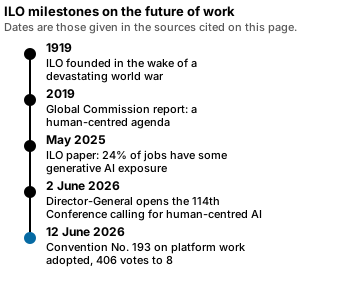
The best-known document is Work for a brighter future, the 2019 report of the Global Commission on the Future of Work1. It frames the ILO’s role against its origin: governments, employers and workers came together in 1919 to found the organization out of a shared commitment to social justice1. The Commission’s starting claim is that technology will create new jobs, but that those who lose their jobs in the transition may be the least equipped to seize the new opportunities1. It adds that today’s skills will not match the jobs of tomorrow, and that newly acquired skills may quickly become obsolete1.
The report sets its warnings against a baseline of existing problems, summarized here.
| Baseline figure in the 2019 report | Value |
|---|---|
| Jobs to create by 2030, on top of unemployment today | 344 million, plus 190 million1 |
| Workers in extreme poverty | 300 million1 |
| Share of the global workforce working excessive hours | 36.1%, more than 48 hours a week1 |
| Pay gap, women against men | Around 20%1 |
| Households with internet access | 53.6%, only 15% in emerging countries1 |
The Commission also records that the share of national income going to workers has declined1. That is the background to its call to reinvigorate the social contract that gives working people a just share of economic progress1.
The human-centred agenda: three pillars
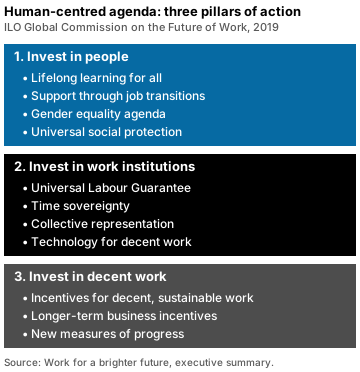
The Commission proposes a human-centred agenda that strengthens the social contract by placing people and the work they do at the centre of economic and social policy and business practice1. The agenda consists of three pillars of action1.
| Pillar | What it asks for | Examples in the report |
|---|---|---|
| 1. Increasing investment in people’s capabilities | Skills, transitions, equality, protection | A universal entitlement to lifelong learning; universal social protection from birth to old age; a measurable gender equality agenda1 |
| 2. Increasing investment in the institutions of work | Rules and representation that fit new forms of work | A Universal Labour Guarantee; greater autonomy over working time; collective representation through social dialogue1 |
| 3. Increasing investment in decent and sustainable work | Where investment goes | Incentives for investment in key areas, and reshaped business incentive structures for longer-term approaches1 |
Two proposals in the second pillar carry most of what came later. The first is the Universal Labour Guarantee: all workers, regardless of their contractual arrangement or employment status, should enjoy fundamental workers’ rights, an “adequate living wage”, maximum limits on working hours and protection of safety and health at work1. The second is a “human-in-command” approach to artificial intelligence, so that the final decisions affecting work are taken by human beings1. The report adds that an international governance system for digital labour platforms should require platforms and their clients to respect certain minimum rights and protections, and that technology demands regulation of data use and algorithmic accountability1. Those two sentences are the seed of the 2026 Convention described below2.
On delivery, the Commission calls for countries to set national strategies on the future of work through social dialogue between governments and workers’ and employers’ organizations1. It also recommends that all relevant multilateral institutions strengthen their joint work on the agenda1.
What the Commission said about technology and jobs
The 2019 report sets out estimates from other studies in a table, and the spread is wide1.
| Estimate listed in the report | Figure |
|---|---|
| Frey and Osborne | 47% of workers in the United States at risk of having jobs replaced by automation1 |
| OECD, 2016 | An average 9% of jobs in the OECD at high risk; between 50% and 70% not substituted entirely, with a large share of tasks automated1 |
| World Bank, 2016 | Two-thirds of jobs in the developing world susceptible to automation1 |
| World Economic Forum, 2018 | Nearly 50% of companies expect some reduction in their full-time workforce by 20221 |
| ILO, 2018, climate | About 6 million jobs lost and 24 million gained from implementing the Paris Climate Agenda1 |
The same table lists demography. By 2050, the total dependency ratio is projected to increase sharply in Europe (by 24.8 percentage points) and Northern America (by 14.4 percentage points), while for Africa it is projected to decrease by 18.7 percentage points1. Ageing regions and young regions face opposite pressures. For how these studies compare and why they disagree, see how many jobs automation will replace.
Skills and lifelong learning: ILO, employers and the GTCI
The skills proposal in the 2019 agenda is specific: a universal entitlement to lifelong learning that enables people to acquire skills and to reskill and upskill1. Employers surveyed by the World Economic Forum for its Future of Jobs Report 2025 point the same way. 85% of employers surveyed plan to prioritize upskilling their workforce, and they name funding for reskilling and upskilling (55%) and provision of reskilling and upskilling (52%) as the two most crucial public policy measures6. The WEF page on skills and jobs sets out the detail by edition.
The Global Talent Competitiveness Index reaches the same issue from the country side. Its 2020 edition, on artificial intelligence, concluded that the emergence of AI in the workplace requires a massive re-skilling of the workforce7. Its 2017 edition added an Employability sub-pillar that measures the extent of skill gaps and labor market mismatches in each country8. The measurement view and the entitlement view are two ends of one argument: the index scores what a country does about skills, and the ILO proposes what it should guarantee. For the mismatch evidence itself, see skills mismatch.
What the ILO has added since 2019
Two later items matter for readers tracking technology.
The first is a 2025 ILO working paper on generative AI, whose revised index puts one in four workers globally in an occupation with some generative AI exposure, and 3.3% of global employment in the highest exposure category5. Exposure is higher in rich countries: 34% of total employment in the high-income group and 11% in the low-income group5. The paper stresses that exposure does not imply the immediate automation of an entire occupation, but rather the potential for a large share of its current tasks to be performed using this technology5. For most occupations, transformation is the most likely impact, because most occupations consist of tasks that require human input5.
The second is the speech that opened the 114th International Labour Conference in Geneva in June 2026. The Director-General opened the Conference with a call to place people at the centre of the artificial intelligence revolution3. His line: the future of work will not be determined by technology alone, but by the policies, institutions and social dialogue that guide it3. He called for a human-centred approach to AI and a strategic agenda built around four pillars: rights, employment and skills, social protection and social dialogue3. Productivity gains, in his words, must be distributed fairly through better wages, stronger labour protections and more inclusive growth3. The Conference brings worker, employer and government delegates from the Organization’s 187 Member States3.
Convention No. 193: what the platform-work standard requires
On 12 June 2026, at its 114th session in Geneva, the International Labour Conference adopted the Decent Work in the Platform Economy Convention, 2026, which is Convention No. 1932. It received 406 votes in favour, 8 against and 36 abstentions, as ILO News reported4. It is the first international labour standard specifically designed to address working conditions in the digital platform economy4. It responds to the rapid growth of digital labour platforms and of the workers who earn their livelihoods through platform work, including ride-hailing, delivery and online freelance services4. If adopted, the standards would be the first focused on the impact of digitalization in the world of work3.
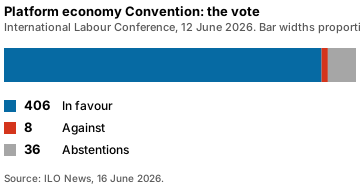
Worked example (our arithmetic). The vote in plain shares, using the three figures reported4.
| Step | Calculation | Result |
|---|---|---|
| Votes cast | 406 + 8 + 36 | 4504 |
| In favour, share of votes cast | 406 ÷ 450 | about 90%4 |
| In favour, share of votes for or against | 406 ÷ (406 + 8) | about 98%4 |
Who and what it covers
The Convention defines a digital platform worker as a person employed or engaged to work for the provision of service organized or facilitated by a digital labour platform, for remuneration or payment, regardless of their classification of status in employment2. It applies to all digital labour platforms and to all digital platform workers, whether in the formal or informal economy2. A Member may exclude limited categories of platforms or workers from all or part of it, after consulting representative organizations of employers and workers, and must give the reasons for the exclusions in its reports2.
The main obligations
| Topic | What each Member must do |
|---|---|
| Fundamental rights | Respect, promote and realize freedom of association and collective bargaining, and a safe and healthy working environment, in the platform economy2 |
| Safety and health | Prevent occupational accidents and diseases; protect workers’ right to remove themselves from imminent and serious danger without undue consequences2 |
| Violence and harassment | Protect all platform workers, including against online harassment and harassment by clients and customers2 |
| Status | Ensure correct classification of workers in respect of the existence or non-existence of an employment relationship2 |
| Pay | Employees receive at least the applicable minimum wage, excluding tips2 |
| Social security | Access on terms no less favourable than for other workers with the same status2 |
| Algorithms | Platforms inform workers about automated systems that monitor or evaluate work or generate decisions2 |
| Decisions | A written explanation of significant adverse decisions, and a review of decisions on unpaid amounts, suspension, deactivation or termination2 |
| Data | Right to request access to, and rectification and erasure of, personal data2 |
| Deactivation | Prohibit suspension or termination based on discriminatory or otherwise unlawful grounds2 |
| Migrants | Prevent abuses of, and protect, migrants and refugees recruited or working as platform workers2 |
Two provisions answer the Commission’s call for human control. Where decisions are generated by an automated decision-making system, each Member must ensure that platforms have appropriate human involvement2. And the terms of engagement should preferably be governed by the laws of the country where the work is performed, unless national laws or international agreements provide otherwise2. The Convention also asks governments to promote decent work and to encourage career and skills development in the platform economy2, and to facilitate formalization, including registration of self-employed workers2.
What the Convention does not do yet
A convention binds only the Members whose ratifications have been registered with the Director-General2. It comes into force twelve months after the ratifications of two Members have been registered, and for any other Member twelve months after its own ratification is registered2. Each Member implements it in consultation with the most representative organizations of employers and workers2. Adoption alone therefore changes no national rule. For ratification status, check the ILO’s own register of ratifications, which this page does not track.
Which ILO document answers which question
- What should governments aim for? The 2019 report and its three pillars1.
- How exposed are jobs to generative AI? The 2025 working paper, read as exposure, not loss5.
- What must platforms and states actually do? Only the adopted text of Convention No. 193, and only for states that ratify it2.
- How do countries compare on talent and skills? Not the ILO: the GTCI methodology explains the index that measures it.
Read next
Policy and work
WEF Future of Jobs report: skills on the rise, 2025
AI and big data top the skills on the rise in the Future of Jobs Report 2025. Core skills, growing and declining jobs, and how it changed since 2020 and 2023.
Talent and technology
How many jobs will automation replace? Studies compared
Estimates run from 9% to 47% of jobs, from 85 million displaced to 170 million created. Why Oxford, OECD, ILO and WEF disagree, and which jobs sit where.
Skills and mobility
Skills mismatch: OECD definitions, data and costs
What skills mismatch means, how the OECD and ILO measure it, how many workers are affected by country, what it costs in wages and productivity, and what helps.
Sources
- Work for a brighter future: Global Commission on the Future of Work · International Labour Organization, 2019 · ilo.org · checked October 21, 2026
- Convention concerning decent work in the platform economy (No. 193), adopted text · International Labour Organization, 114th International Labour Conference, 12 June 2026 · ilo.org · checked October 21, 2026
- Opening of the 114th International Labour Conference: the future of work will not be determined by technology alone · ILO News, 2 June 2026 · ilo.org · checked October 21, 2026
- New ILO convention on platform work offers important safeguards for workers in Türkiye · ILO News, 16 June 2026 · ilo.org · checked October 21, 2026
- Generative AI and Jobs: A Refined Global Index of Occupational Exposure (ILO Working Paper 140) · International Labour Organization, May 2025 · ilo.org · checked October 21, 2026
- Future of Jobs Report 2025 · World Economic Forum, January 2025 · www3.weforum.org · checked October 21, 2026
- The Global Talent Competitiveness Index 2020: Global talent in the age of artificial intelligence · INSEAD, the Adecco Group and Google, GTCI 2020 · globaltalentcompetitivenessindex.org · checked October 21, 2026
- The Global Talent Competitiveness Index 2017: Talent and technology · INSEAD, Adecco Group and HCLI, GTCI 2017 · globaltalentcompetitivenessindex.org · checked October 21, 2026
Image credits (3)
Published . Rankings change with every edition: each figure names its edition year and each source shows the day it was checked. How we check facts · Report an error.